Everything the game does, in the order you will run into it.
The same pages are in the app under Help — nothing here
is hidden behind a tutorial.
Moving the frame
Press and hold anywhere on the screen — you do not have to
touch the frame itself — and drag. The frame keeps the
offset it had when you first touched down, so it never snaps
under your thumb and your aim stays where you put it.
Let go and the frame stops. It cannot leave the screen, so the
edges are a hard limit on where you can retreat to. Flick as
hard as you like: the frame catches up to your finger rather
than teleporting to it, so a wall can never sweep straight past
the ball.
The ball is not attached to any of this. It carries its own
speed and direction, bounces off solid wood, and does not care
where you are dragging.
What you score
Two numbers, tracked every run:
Number
How it goes up
Bounces
+1 each time the ball strikes a solid wooden section. One continuous contact only counts once, so sliding along a plank does not farm points. Everything the ball catches adds to this same number.
Survival time
Runs from the moment the round starts until the ball escapes.
Your best of each is kept on the device, per rating band. They
are tracked separately, so a long careful run and a short
frantic one can both be personal records.
What the forest drops
The playfield is not empty, and the ball is the only thing that
can touch any of it. Moving the frame to put the ball somewhere
is the whole game; these are the reasons to.
Kind
What it does
Worth
Falling
Nuts and cones drop from the top, one at a time, every two or three seconds. One that reaches the bottom uncaught bursts where it lands.
1
Blown
Leaves and seeds cross sideways on the wind, in gusts of four to ten flying close together at the same speed. The slowest things in the game, and the easiest to line up.
2
Growing
Berries and mushrooms sprout along the bottom and swell where they stand, reaching full size in fourteen seconds. Six at most are ever out at once, and they do not go anywhere.
1–5, by ripeness
Golden orb
Repairs the frame instead of scoring. See below.
—
Chain, splitter, magnet, boxit
Four objects that cross the field and change the
run rather than paying for it — see below.
—
Nothing is ever taken off you. A nut that lands, a leaf that
blows past and a berry left to ripen all cost you the catch and
nothing else — which makes leaving a berry to fatten a
real decision rather than a risk.
Each of the six backdrops brings its own set of items, drawn for
it: acorns and blackberries in the forest, frosted cones in the
snow, husks and bone in the desert, glowing minerals in the
cave. 279 of them in all, and each one shatters into its own
colours when the ball takes it. Each place plays its own music
too, not only its own art. Every one of
them is pictured here.
Things that cross the field
Besides the orb, three objects drift through a run. All three
are exactly the ball’s size and turn slowly as they go, so
they read as one family: things you have to decide about. None
of them pays a point on contact. What each one does
is change the run you are in.
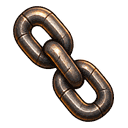
The chain — avoid it
Hit it and the frame locks where it stands for
2 seconds.
A golden countdown appears in the middle of the
screen. Nothing else stops: the ball keeps flying,
the clock keeps running, the wood keeps opening. You
are simply made to watch.
It is the only thing in the game that takes the
frame away from the finger holding it, so it is
worth steering wide of even at the cost of a catch.
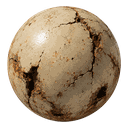
The splitter — take it
A cracked stone. Your ball bounces off it and the
stone opens into a second ball. From then on the run
ends only when both are gone, which is
close to a second life — but it is a second
life you have to steer, with one frame.
Two balls bounce off each other, and no stone
appears while you already have
2. Lose one and
another can turn up.
The magnet — chase it
The rarest thing you will see, roughly once every
45–75
seconds. Hit it and every item on screen is dragged
to your ball and popped as it arrives, each one
paying what it was worth.
The near things land first and the far ones trail in
behind, so it is worth taking when the field is
full — the middle of a gust is the best moment
there is.
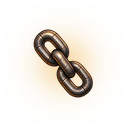
The boxit — take it
The chain again, but glowing gold, and about as rare
as the magnet — every
45–75
seconds. Hit it and chains fall across every hole in
the frame, corners included, for
2
seconds.
The frame still moves and the wood still rots; you
simply cannot lose the ball while the chains are up.
A small number counts the seconds down. It is two
seconds to stop steering and go and take something.
The golden orb — the one that buys time
Covered in full below. It is the only object that
repairs the frame, and like the rest it pays nothing
on contact.
The gold one, and the streak
Every gust of wind carries one item that glows gold and
trails a short golden wake. It is an ordinary leaf in every
other way — it blows the same, and on its own it is worth
the same 2.
Catch that one and the whole gust pops, one after
another, each paying its own worth. A ten-strong gust taken at
the gold one is ten catches from a single interception, which
makes reaching that particular leaf the most valuable thing you
can do with a gust.
It is always a gust, never a falling nut or a berry. Those
arrive in ones and twos, so there would be nothing for a gold
one to set off.
Hitting the same thing twice in a row doubles it
Catch two acorns back to back and the second pays double.
The third doubles again, and so on up to
32 times,
where it stops climbing — with the multiplier written
over each catch in gold and a chime to match. Catch
anything else and it starts over at one.
A gust is all of one kind, which is the point: threading the
ball through a gust catching leaf after leaf is worth far
more than the same leaves caught with anything in between.
Why it gets harder
Every side of the frame starts whole. Nothing opens on a clock
— a plank cracks only where the ball actually hits it, and
the third crack breaks it, leaving a hole where that plank was.
Cut into five to eight planks of random widths every round, a
side breaks unevenly: some collapsed planks leave a hole wide
enough for the ball, others do not, and you can see which by
looking at the gap.
There is no permanently solid corner holding the box together,
and there never was one to lose: a corner is just a gap too
narrow for the ball on its own, and it only opens up once the
planks on both sides of it are gone. Late runs are about
watching those corners, not just the walls.
Wood does not grow back on its own, and it does not wait for
the ball to move clear either — the one repair in the
game rebuilds a plank right under the ball, on purpose, to
bounce it back in. See the golden orb below.
The crack tells you what is coming
Each hit leaves its mark on the plank it landed on, and the
mark right before a plank breaks always looks the most
battered, at any rating. A glance at the wood is enough to
tell you which one is about to go.
Standing still is the one exception to “nothing opens on
a clock”. Leave the frame exactly where it is and
10 seconds later
every surviving plank takes a crack at once — a puff of
dust off the wood warns you
2 seconds
before it lands — and it keeps happening, on the same
clock, for as long as you hold still. Move the frame at all and
the clock resets. The one break: while a boxit has your frame
chained, the clock is frozen too — you already cannot move
it, so it does not also decay under you.
The golden orb
A glowing orb drifts into play from time to time — one at
a time, never more. Collecting it banks a rescue charge; you can
hold up to
3 at once, shown as a
row of small orbs along the bottom of the screen. Spend one and
the plank the ball was about
to escape through rebuilds on the spot, right under the ball, and
bounces it back inside instead. While you are holding a charge
the ball itself shows it too, flecked with gold as it rolls.
The catch is that you cannot collect it yourself. The orb
ignores the frame completely: it drifts straight through wood
and openings alike, and moving the frame onto it does nothing at
all. Only the ball can take it.
So collecting one means steering the entire frame to put the
ball on a path that crosses the orb — usually while at
least one wide-open side is pointed somewhere you would rather
it was not.
Missing costs you nothing. The orb drifts off the screen, is
removed, and another is scheduled later. There is no penalty for
letting a bad one go, which makes ignoring the greedy ones a
real strategy rather than a concession.
Levels, rating and bands
Two separate numbers, and they are easy to confuse. Levels
are a record of time put in: every run pays a point of
experience a second, plus ten for finishing at all, so even a
four-second run moves the bar. Levels cost more as they go
— a hundred for level 2, two hundred more for level 3,
three hundred more for level 4 — they only ever climb, and
new ones unlock things to look at: the Autumn, Moonlit and Snow
Cabin backdrops at levels 3, 8 and 15, and a new wooden frame
every few levels from the second on. The Desert and the Crystal
Cave, a temple frame and a golden ball come with Boxscape
Premium instead, a one-time purchase that also removes the
ads between runs. Nothing you unlock or buy changes how the game
plays or scores; it changes what you look at while it does.
Your rating is how well you play, and it moves both ways.
Surviving about ninety seconds is par: beat that and it climbs,
fall short and it drops. The game serves a difficulty to match
it: the ball reaches full speed in as little as ninety seconds
for the strongest players and as long as three minutes for
players still finding their feet, and a plank takes fewer hits
to break the higher your rating climbs.
Band
Rating
Rookie
below 840
Amateur
840 and up
Skilled
1080 and up
Pro
1320 and up
Elite
1560 and up
You are promoted the moment you cross a line and have to fall
fifty back below it to be demoted, so a rating sitting on a
boundary does not bounce you about. Best time and best bounces
are kept per band, so a promotion never means chasing a record
you set at an easier setting.
One more chance, and the ads
On Android the game is free and pays for itself with ads. None
of them play while the ball is in the frame, and two of the three
only play if you ask.
One more chance. When the last ball gets away, the playfield freezes and a card offers to bring it back for a short ad. You have five seconds to decide; do nothing and the run ends as normal. Watch the ad to the end and the plank the ball left through is rebuilt with the ball inside it, and you carry on from the same time and the same bounces. Once per run.
Double XP. On the results board, if no ad has played that run, a DOUBLE XP plank offers to pay the run's experience a second time for an ad. Experience only, so it only ever moves the level bar.
A short break. From the sixth run on, every fourth PLAY AGAIN shows a full-screen ad first — never straight after one of the two above, and never on a board that is already showing you a new backdrop, a promotion or a trophy. Boxscape Premium removes these entirely; the two optional ads stay available to Premium players.
A continued run is played for the pleasure of it. It pays
experience like any other, but it stays off the leaderboards and
your personal records, its rating change is skipped, and the
trophies judged on one run's time or bounces do not count it, so
nobody's place on a board was bought with an ad. The results
board says CONTINUED beside the time when that is what happened.
In the European Economic Area, the United Kingdom and Switzerland
the game asks your permission before showing any ad at all; the
privacy policy has the detail.
Trophies and the boards
There are 118 trophies. Some are for a single run, some for
lifetime totals, some for coming back the next day. They arrive
mid-run on a card that flies past without stopping the game and
collect in a row under the plaques. Awards is what you
hold, one card each; the Gallery, reached from Awards, is
the whole catalogue with the ones you have not won dimmed rather
than hidden, so you can see what the game wants from you.
Three global boards sit behind the Scores icon: Time ranks the
longest run, Bounces the highest count, and Trophies the biggest
shelf — a total that only ever climbs. Your own row is
always shown, wherever it ranks, at its true position rather
than renumbered to fit. The heading reads GLOBAL SCORES over
real players and BEST SCORES over the game's own five fixed
rivals, so the two are never confused. A run you continued by
watching an ad is not sent to any of the three.
The game names you the first time it runs and never asks for
anything else. What that means for your data is in the
privacy policy.
Getting further
Corners never break, but they are not safe. There is no plank there to crack, only a gap too narrow for the ball on its own — until the planks on both sides of it are gone.
Move the frame, not your expectations of the ball. The most common way to lose is chasing where the ball is instead of putting wood where it is going.
Short drags beat long ones. Big sweeps rotate which opening faces the ball's path, and that is usually what kills a good run.
Let the berries ripen. They are worth five times as much at full size and they are not going anywhere. A gust, by contrast, is gone in seconds.
Turn down a bad orb. Missing is free. A charge you spend on the wrong gap is a charge you do not have later.
Watch the side you cannot see. The opening that ends the run is almost never the one you were looking at.
Never stop dragging. Park the frame for ten seconds and every plank cracks at once, wherever it is. Small, constant corrections cost nothing; standing still costs the whole frame.
 Boxscape